Callahan's Kind of Cool
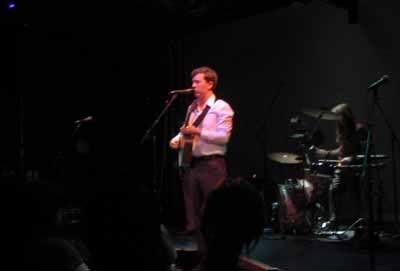
Assured, sharp, cool (tempered, comfortable in his own skin), Bill Callahan took to the stage of the Echoplex at around 11:20 last night and got down to business. Notably it wasn't (Smog) who performed. (Smog) being Callahan's moniker from his earliest days on the indie scene back in 1988. This time around, he's simply Bill Callahan, touring in support of his album "Woke on a Whaleheart." And Callahan, with a company of incredible musicians (bass, violin, and a percussionist who worked it standing up), put on an excellent show.
Callahan's songs all came off well, his trilling, mildly low voice ushered his lyrical loops while the music often started of spare and would build, slowly, to a cacophony made all the more impressive given the presence of only 4 people on stage. At times the sound seemed bigger than all of them. Like how the energy of the more propulsive track, "Diamond Dancer," was palpable. The percussionist, who heretofore was exemplar with his subtlety and controlled erratics and atmospherics, suddenly thundered a hard 4/4 beat, while the violinist hit a higher and more haunting register than she had with other songs, peeling askew and gorgeously shrill, with hints of lamenting vibrato. And of course, Bill, his expressive maw, hollering in this calculating, controlled sense.
And that was the essence of the whole show. It was experimental in that the songs all had the space to lumber and exist on a very mellow level. The music was imbued with a sense of composure, subsumed by the very necessity of the songs. That's what I was ultimately left with, Callahan's necessity. Necessary, as in, it's necessary to hear him sing to you, and because the venue was small and only half-filled, it felt like he was addressing us. It was necessary to hear him sing,"Oh I never really realized death is what it meant to make it on my own," in an excellent rendition of "Say Valley Maker." That was the line that stayed with me the most. He's saying that we're all in this together right now, in this moment (you can be alone when you die).
Labels: (smog), bill callahan, death, music, shows
posted by Adam at 10:59 AM
1 comments