Friday, October 05, 2007

Africambiguities

Photo Sharing and Video Hosting at Photobucket
Holland Cotter exalts the "sleeper" exhibit, “Eternal Ancestors: The Art of the Central African Reliquary” at the Met in NYC. Cotter just short of begs museum goers to give up the modernist, western focused ghost, if only for a second, and, like, totally check out this little exhibit, because, you'll totally get something out of it, I swear. Which is an interesting thought because so much of what marks modern art is its lack of substance, or its theoreticalness, or its opaqueness. And suddenly, seemingly rudimentary, savage works, boring pedagogical fodder (thus the traditionally "sleeper" section of the museum) at least in this article, are suffused with meaning. The meaning being the historical connections between African and European treatments of their dead. Cotter somewhat bemoans the need for Euro connections, but hell, the Met has to get people in there somehow. And then:
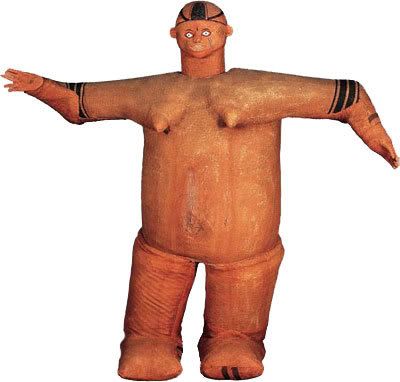
The show ends theatrically too, though whether with tragedy or comedy is hard to say. One of the final images [above] is also one of the most startling: a reliquary figure from Congo. Standing six feet tall and made from layers and layers of cloth, including red European blankets, the figure is bulked up to resemble a giant female doll, all but nude, with brick-red skin and a smile of what looks like avid glee on her face.

Who is she? What is she? Several things. She is a portrait of someone who has died and also a receptacle for that person’s mummified body. She is an image of a specific category of ancestor, one recently dead. But she will fully claim status only after she has been buried with the relic she holds.

So she's ultimately a kind of metaphysical object, a body within a body that constitutes a whole only when a) she's dead and b) contained within her depiction. Crazy interesting. No sarcasm here. Cotter wins me over at the end of the piece with, " The lesson: In death, as in life, ambiguity rules." Yes! Ambiguity totally rules!

Keeping Watch Over the Dead [NYT]

Labels: , , , , , ,

Tuesday, August 21, 2007

de Young, and the Rest(less)

Photo Sharing and Video Hosting at Photobucket
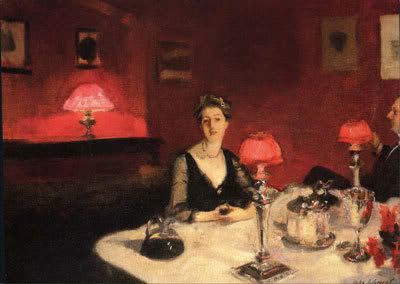
John Singer Sargent's A Dinner Table at Night, on display as part of the permanent collection of the de Young Museum, San Francisco.

Last week I had the pleasure of revisiting the de Young Museum in Golden Gate Park, San Francisco. A year later, the museum itself is blending more and more into the park's greenery as the metal oxidizes on the stunning structure's exterior.

Just through with the featured exhibition of Hiroshi Sugimoto's photographs (I'll get to those in just a moment), I came across the above painting on display as part of the museum's permanent collection of American paintings. John Singer Sargent's, A Dinner Table at Night, 1884. I knew nothing of the painter or the work, but was drawn to it beyond all others in the room. Something about the red permeating everything, then a closer look reveals the woman's face to be kid of blurry. Then the silvery touches on the lamps and the glint on the decanter. And we can't ignore the smoking man cropped off the right edge. And see her hand gripping her glass? Is this the first glass of the evening? There's something tender and strange about this painting. It's either conjuring the mild glow of romance, but better yet, maybe it's the warm feeling of a good glass of wine kicking in, or a sense of isolation or longing or nostalgia. Not sure. But the painting is incredible.

Photo Sharing and Video Hosting at Photobucket
Hiroshi Sugimoto retrospective show at the de Young Museum, San Francisco.

The Sugimoto retrospective was interesting, masterful, if not a little sterile in its detached and methodical experimentation. The above seascapes were mounted on a long, dark wall. Each shot a different sea, calibrated to align on the horizon. Each sea is different and alike in ways. The work is meditative and compelling taken all of a piece.

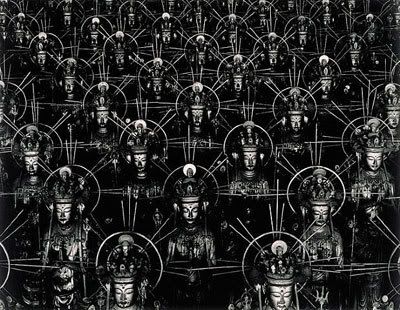
On the other side of this long wall/corridor was my favorite of his pieces, Sea of Buddha, 1995 (below). The 48 photographs of 1001 sculptures were taken in a 12th-century temple in Kyoto Japan. Each sculpture is different with each head adorned with a mini cosmology of smaller heads and shrines. The effect of all the photographs displayed in a row was thrilling. These sculptures, over 900 years old, remind me of the female automaton in Fritz Lang's film Metropolis. I was stunned by the ornate art deco feeling I was getting from this. But looking close removed that sense somewhat, revealing these faces and posing questions. Who made these statues? Are these faces based on real people? Why must I analogize this work to a 20th century movement? Is this sense intentional? Does is matter?

Photo Sharing and Video Hosting at Photobucket

The presentation of the statues, and all the photographs in the exhibit, was flawless. My major complaint was that the wall-text accompanying each section consisted of Sugimoto's words on the pieces. He came off as obtuse and heavy-handed. I would have preferred a more objective curatorial voice, but that's me.

Other notable works were Sugimoto's blurry shots of famous works of architecture (Chrysler Tower, World Trade Center, etc...), as well as shots of movie theaters for which he held open the camera shutter for the entire length of the film, revealing pure white on the screen and a glow subtly lighting the environment from the screen giving the environments a silken texture. And all the theaters were empty creating an overall beautiful yet cold effect, like the entire retrospective, really. But the show and the visit to the museum provided what museums should do best: musings.

P.S. Seargent and Henry James were friends, soul mates even!
Here is a NY Times article by Deborah Weisgall from 1997 chronicling Sargent's relationship with novelist Henry James. Both were American artists flourishing abroad. I like this line, "Like James, Sargent tells us everything about his subjects, only to compound their essential mystery."

Labels: , , , ,